How NOT to Be Vanilla in Business: Build a Business People Actually Remember!

Written by Karen Davies
When you think about creativity, what comes to mind?
Perhaps you think about drawing, painting, graphic design or being naturally artistic but creativity in business is something much bigger than that.
It’s the ability to think differently… to solve problems, to spot opportunities and to take an idea and turn it into something that didn’t exist before.
If you’ve ever started a business, created an offer, launched a service or found a different way to solve a problem for your customers then you’ve already used creativity whether you consider yourself a creative person or not.
In a crowded online world where we’re all competing for attention, creativity could actually be one of the most valuable skills you develop as a business owner.
In a recent episode of Online Business Uncovered, I spoke to Jodie Newman, founder of The Business Allotment, about why creativity matters so much in business and how thinking differently can help you create a brand people actually remember.
Creativity isn’t just for creative people
One of the biggest misconceptions around creativity is that you’re either creative or you’re not.
I’ve heard so many business owners say “I’m just not very creative” and yet these same people have created businesses from nothing. They’ve developed services, named their business, solved client problems, marketed themselves and turned ideas into reality. That’s creativity.
As Jodie explained during our conversation, artistic talent and creativity are not the same thing. Creativity is a skill that can be practised and developed and that’s particularly important for entrepreneurs because growing a business often requires us to move beyond what Jodie describes as “business as usual thinking.”
Business as usual thinking helps us run the business we’ve already created. We know what needs doing, we understand our clients and we know how to deliver our services but growth often requires something different. It requires business as unusual thinking. We have to look beyond what we’ve always done and ask what else could be possible?
Why so many businesses become forgettable
Take a look around almost any industry and you’ll notice something interesting… businesses often start to sound exactly the same. They use similar language, they make similar promises, they structure their services in similar ways, they create similar content and they even onboard their customers in similar ways.
When everyone starts saying the same thing, it becomes incredibly difficult for customers to remember who is who. This becomes even more important as AI makes it easier than ever to create content.
AI can be an incredibly useful tool but if we’re simply publishing whatever it gives us without adding our own ideas, experiences, opinions and personality, we risk creating more of the same and more content isn’t necessarily what our businesses need… we need to become more memorable!
Your story can become your competitive advantage
One of the areas Jodie believes businesses often don’t apply enough creativity to is their brand story because I found this particularly interesting because for years I felt uncomfortable sharing my own story. I worried it might feel self-indulgent and also why would anybody care about my journey?
Interestingly, I’ve discovered the opposite because whenever I’ve shared the experiences that have shaped my business, people have connected with me differently. They’ve heard something in my story that reflects where they are now and they’ve thought “That’s exactly how I feel” or “That’s where I want to get to.”
Your story gives context to what you do as it explains why you care about the problem you solve and why you approach it in the way you do. Crucially, nobody else has exactly the same story as you. Jodie made an important point during our conversation: your story isn’t simply there for you.
Your story is there to serve your prospective customers.
When someone discovers your business, one of the questions they’re ultimately trying to answer is ‘why should I choose you?’
Your experience, beliefs, approach, personality and perspective can all help them answer that question.
Stop trying to appeal to everyone
There’s another side to becoming memorable that we don’t always talk about. Some people won’t like it and that’s okay.
Jodie shared a brilliant example during our conversation of someone telling her very directly that they hated her branding. Rather than seeing this as a disaster, she saw it as validation as her brand had created a reaction. The opposite would have been somebody looking at her business and thinking “I could take it or leave it.”
Trying to make your business appeal to everyone can actually strip away the very things that make it interesting. Your language, personality, ideas and beliefs naturally attract some people and repel others. That’s not necessarily a problem as the goal isn’t to create a business everybody likes. It’s to create one the right people remember.
Stop looking at what everyone else is doing
One of the easiest traps to fall into as an entrepreneur is constantly looking sideways. You want to create an onboarding process, so you search Google to see how other businesses do it. You want to launch something so you look at somebody else’s launch. You want to create a course, so you study other people’s courses. There’s nothing wrong with research but there is a danger that we start borrowing everybody else’s ideas. Before long, our business starts looking suspiciously like everyone else’s.
Sometimes the best thing you can do is go back to a blank page. Instead of asking “how does everyone else do this?”… try asking “how could I do this?”
For example, if you’re creating a new customer onboarding experience, don’t immediately start with the process, start with the outcome and ask yourself the following questions…
- How do you want somebody to feel after experiencing it?
- What do you want them to think?
- What do you want them to do?
- What would make them tell somebody else how brilliant the experience was?
Starting with those questions opens up far more possibilities.
Give your brain permission to have ridiculous ideas
When we’re running businesses, we’ve trained ourselves to be sensible as naturally, we want things to work. We want evidence and we want data to validate our ideas. We want reassurance that the idea we’re investing our time and money into is going to succeed but creativity doesn’t always work like that.
Sometimes you need to give yourself permission to come up with ideas that are completely ridiculous because buried amongst those ridiculous ideas could be something brilliant.
Jodie encourages business owners to practise divergent thinking: instead of immediately looking for the right answer, generate lots of different answers. Imagine picking an everyday object and giving yourself 60 seconds to think of as many different uses for it as possible. Some ideas will be obvious, some will be completely ridiculous and that’s the point. You’re training your brain to move away from its familiar pathways (and you can do it in just one minute a day!).
Creativity needs space
There’s another important part of creativity we often forget is that you can’t always force your best ideas.
How many times have you sat at your desk thinking “I need an idea” and absolutely nothing happens?
Then you’re walking, swimming, driving or standing in the shower and suddenly the answer appears. I’ve experienced this myself as some of my best ideas arrive while I’m swimming or in the shower rather than sitting at my desk actively trying to solve the problem.
Jodie explained how she’ll sometimes write down a challenge, fold up the piece of paper, put it away and deliberately stop thinking about it for a few days. The idea is to give your subconscious space to work on the problem rather than continually forcing your conscious mind to find the answer. For business owners who spend most of their time doing, this can feel counterintuitive but sometimes stepping away from the problem is exactly what allows the solution to appear.
Get comfortable with failing
Creativity also requires something many of us become increasingly uncomfortable with as we become more experienced.
Failure.
When you’re an expert at what you do, you probably don’t fail very often at the core work you deliver because you know what you’re doing but that can make experimenting with something new feel incredibly uncomfortable.
What if the launch doesn’t work?
What if nobody buys?
What if the idea falls flat?
The temptation is to stick with things that have already been proven but if we only ever do what has already worked, we limit our ability to innovate. Not every idea will work, not every product will sell immediately and not every launch will deliver the results you hoped for.
That doesn’t necessarily mean the whole idea was wrong… perhaps one part needs changing. Maybe the messaging needs refining, maybe the audience wasn’t right or maybe the timing was wrong. Creativity involves testing, learning, iterating and trying again.
Find creativity outside your business
One of the things I loved about this conversation was the reminder that creativity doesn’t have to happen inside your working day. Jodie experiments with different crafts. For me, one of my biggest creative outlets is singing. It’s something I rarely talk about but I’ve realised how much it affects the way I feel and work. Singing takes me completely out of business mode. It changes my energy, helps me switch off and often leaves me feeling far more creative when I return to my work.
Your creative outlet might be completely different.
It could be:
- Cooking
- Photography
- Gardening
- Music
- Writing
- Crafting
- Dancing
- Reading fiction
- Trying something you’ve never done before
The activity itself isn’t really the point, it’s about giving your brain opportunities to experience something different.
Your expertise doesn’t have to become a huge course
During the episode, Jodie also shared a preview of what she’ll be teaching at this year’s Online Business Growth Summit. Her session uses what she calls the Chicken Nugget Philosophy to help entrepreneurs take their expertise and shape it into a digital product and I absolutely love the concept.
One of the biggest mistakes I see entrepreneurs make when they decide to create an online course or digital product is trying to include everything they know. You don’t need to because your job is to identify the right nuggets of expertise for the person you want to help. Then you need to consider how those nuggets fit together, what order they need to be delivered in, how you’ll package them and what your own “secret sauce” is that makes your product distinctly yours. Suddenly, creating a digital product feels far less overwhelming. You don’t need to give somebody everything you’ve learned during your career. You need to give them the right information to achieve a specific result.
Creativity could be one of your biggest business advantages
We spend so much time looking for the latest strategy, platform, marketing tactic or piece of technology that will help us grow but perhaps one of the most powerful tools is something we already have… our ability to think, to question, to experiment, to connect seemingly unrelated ideas, to tell better stories, to imagine different possibilities and to create something that doesn’t look exactly like everything else already out there.
You don’t have to consider yourself a creative person, you simply have to be willing to think differently because in an increasingly crowded online world, the businesses that stand out won’t necessarily be the ones creating the most content or shouting the loudest. They’ll be the businesses we remember.
Listen to the full conversation
You can hear my full conversation with Jodie Newman, founder of The Business Allotment, in Episode 172 of Online Business Uncovered: How Creativity Can Help You Build a More Memorable Business.
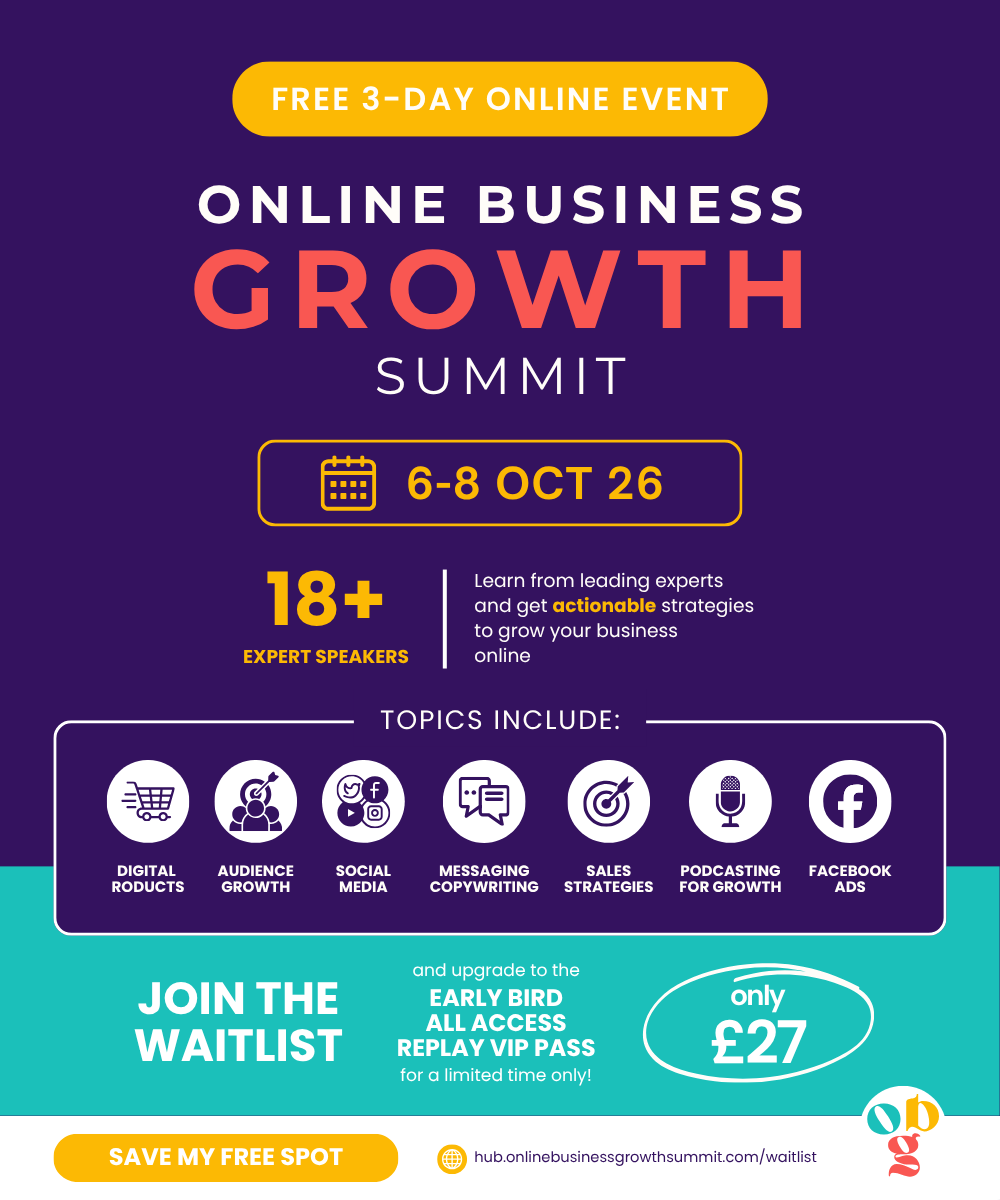
If you’d like to hear more from Jodie, she’ll be joining me alongside 18+ expert speakers at the Online Business Growth Summit from 6th–8th October 2026.
The summit is designed for entrepreneurs who want to create a smarter, more sustainable business, build scalable income and stop relying solely on selling their time.
You can register for free here or upgrade to lifetime access to the recordings and speaker bonuses because creating more freedom in your business doesn’t always mean doing more. Sometimes it starts with thinking differently.
Ready to Build a Business That Creates Freedom?
If you're enjoying this Summit Speaker Series interview, you'll love the Online Business Growth Summit.
Over 3 days, you'll learn from 18+ expert speakers covering everything from creating digital products and online courses to marketing, sales, automation, podcasting, visibility and building a business that generates income beyond your time.
Attend live for free or upgrade to the VIP All Access Pass to watch every session whenever it suits you.
Whether you're just starting to create scalable offers or you're ready to grow what you've already built, you'll leave with practical strategies you can put into action immediately.
Click here to reserve your free place today and start building a business that gives you more freedom, flexibility and choice.
Related Articles
What I’ve learned from bringing 21 experts together for one event
When I first decided to create the Online Business Growth Summit, I knew it was going to be a big project. What I’m not entirely sure I appreciated was quite how big!Bringing 21 experts together for one three-day event has involved a LOT of moving parts. There have...
Why I Decided to Create a Summit (and What I’m Hoping It Will Achieve)
Have you ever had an idea that just wouldn't leave you alone? You know the kind… it pops into your head every so often. You get excited about it (perhaps scribble a few ideas into a notebook and start imagining what it could become) and then promptly put it back on...
The Real Cost of Selling Your Time (And Why More Clients Aren’t the Answer)
One of the biggest misconceptions I see amongst service-based business owners is the belief that more clients automatically lead to more freedom.Now I know this seems logical after all… more clients mean more income (which should mean less stress, more choices and a...